


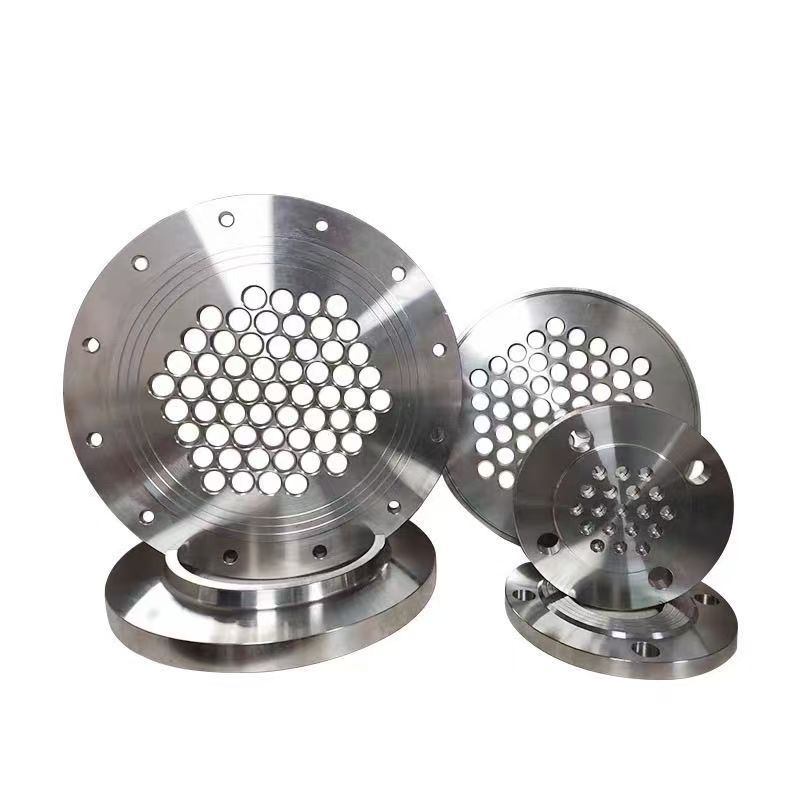
In shell-and-tube heat exchangers, the tube sheet is the componet that silently decides if a plant runs for years or comes to a grinding halt every few months. It provides the tubes, separates two fluids at varying pressure and temperature, and provides the barrier between them. When leakage develops, plant engineers frequently find fault with the tubes or the gaskets first — but in a high proportion of field failures the source is the tube sheet itself: hole position error, out-of-tolerance diameter, poor surface finish, or a tube-to-tubesheet joint that was never able to form a proper seal.
Precision Drilled Tube Sheets and Baffles C.Z.IT Development Co., Ltd. offers precision drilled tubesheets and baffles for heat exchangers, condensers, and pressure vessels. Below is what we see again and again in leak investigations, and what buyers need to know to specify up front.
Where the leak actually originates
Diameter of holes and tolerance drifts. A tube that is too loose in its hole cannot be reliably expanded; a tube that is too tight risks wall thinning in rolling. For ASME built units the hole-to-tube clearance is usually with in the range of 0.025-0.10 mm(0.001-0.004 in), this same discipline must apply ALL OVER the FACE of a 3 meter tube sheet and NOT only in a hole sample.
Error in pitch and pattern. On plan, triangular (30°) and square (45°/90°) configurations are very basic and geometric. In reality, the accumulated pitch error displaces the outer tube rows towards the flange rim, making the ligament between the hole and the outer radius thinner and enabling the creation of a leakage path to the shell side. You can’t go back and rework ligament efficiency after drilling.
Surface finish in the parting zone. The tube-to-tubesheet seals are metallic. Micro-channels such as grooves produced by an old drill or a negligent reamer. A rolled joint over a rough surface can be flawless and yet still weep at 3.8 Mpa on commissioning.
Flatness and thickness variation. a tube sheet that bows when machined or when tubes are welded into it will lead to an uneven preload per tens of thousands of joints. Some joints are over-rolled and under-welded; some never seat.
There one operation to do precision drilling?
Buyers specify the word “drilled”, and implicitly choose every supplier offers the same “drilled”. A tube sheet that is pressured up to withstand leakage is made up of an ordered process:
●Layout and datum hold. Drilling is done from a single datum face and a checked centre so that cumulative errors can never arrive at the rim.
●Rigid drilling, finishing and then Fitz tubes cannot be used in any quotations for say oil rigs unless said tubes are fixed for gradients and bends first of all in rigid drilling then finishing. To save time, holes are drilled slightly under size then reamed or broached to finish size. Reaming produces the straightness and finish upon which rolling and seal welding depend.
● Grooving with depth control. Seal-weld grooves need to have a specific width and depth and a clean corner. Neither a shallow groove nor a jagged one is suitable; the former cannot retain weld metal, the latter acts as a source of cracks.
● Deburring and edge break. The entry edges of the tubes are rounded off, so as not to cut the tube wall when the tube is inserted and then expanded.
● Verification. Coordinate checks hole-by-hole on a CMM or laser tracker, thickness mapping (UT) on forged blanks, and PT/RT as per spec.
At C.Z.IT tube sheets are made on cnc machining centres with programed hole coordinates and the inspection sheet is supplied with the piece. That is the documentation that your QA team uses to sign a U-1A or equivalent data report with no problem.
Changes in machining plan due to material selection
Carbon steel (Q345R, SA-516),2 austenitic stainless (304, 316L, 321), duplex (2205, 2507), titanium (Gr.2), nickel alloys and clad plate all have a different response to drilling. Stainless and duplex work harden; titanium smears and galls; clad plate requires that the drill bit separates cleanly through the base layer without pulling out or damaging the corroded layer at the hole wall. What makes the wrong feed rate is how a tube sheet becomes a scrap sheet — and how a supplier quietly loses tolerance.
The joint method should be compatible with the holes
Precision holes only pay off if they are coupled with the right joint method:
●Strength-expansion for low to moderate pressure and temperature, where both the pull-out strength and the seal are mechanical.
●Seal welding when pressure cycling, thermal cycling or a toxic fluid makes mechanical sealing untrustworthy.
●Expansion weld plus weld for high-integrity services providing the groove geometry and residual clearance are managed so the weld does not crack.
When you go from expansion to seal welding on a retrofit, you typically have to re-spec the tube sheet hole tolerance and groove. That’s a machining conversation, welding is not.
What buyers need to request from their Supplier
When you order a tube sheet, ask for four things, in writing: the hole tolerance and pitch tolerance they will hold, the method they use to verify it, the groove drawing with tolerances, and the surface roughness number at the joint zone. A vendor who spells out in concrete numbers how to answer these three questions is your machining. The reply “standard” is a supplier who’s guessing.
Working with C.Z.IT
C.Z.IT Development Co., Ltd specializes in custom tube sheets, baffle plates, multi-hole perforated plates and flanged parts for heat exchangers, condensers, pressure vessels in carbon steel, stainless steel, duplex, titanium, clad materials to GB, ASME, DIN and customer drawings. Diameter, thickness, hole diameter, pitch, pattern, groove and sealing face are all to your spec.
We also do OEM and private label cooperation. C.Z.IT is our brand, and we also manufacture to your brand, your logo and your packing requirements, so the parts are ready for your customers.
You can send us a drawing or a picture of the damaged tube sheet, our engineers will analyze the hole tolerance, ligament and joint design, then we will give you the quotation.
C.Z.IT Development Co., Ltd. — precision-drilled tube sheets to your drawing, with inspection records.
Post time: Oct-10-2026


