


In the construction or procurement of industrial piping systems, flanges are the basic connecting components used to connect pipes, valves, pumps, and other pieces of equipment. To choose the right type of flange for the conditions of pressure, medium and working environment, pipeline engineers, purchasing managers and manufacturers need know various types of flanges and their sealing face arrangements. In this article, we describe the usual flange classifications and the typical sealing face profiles along with their industry codes.
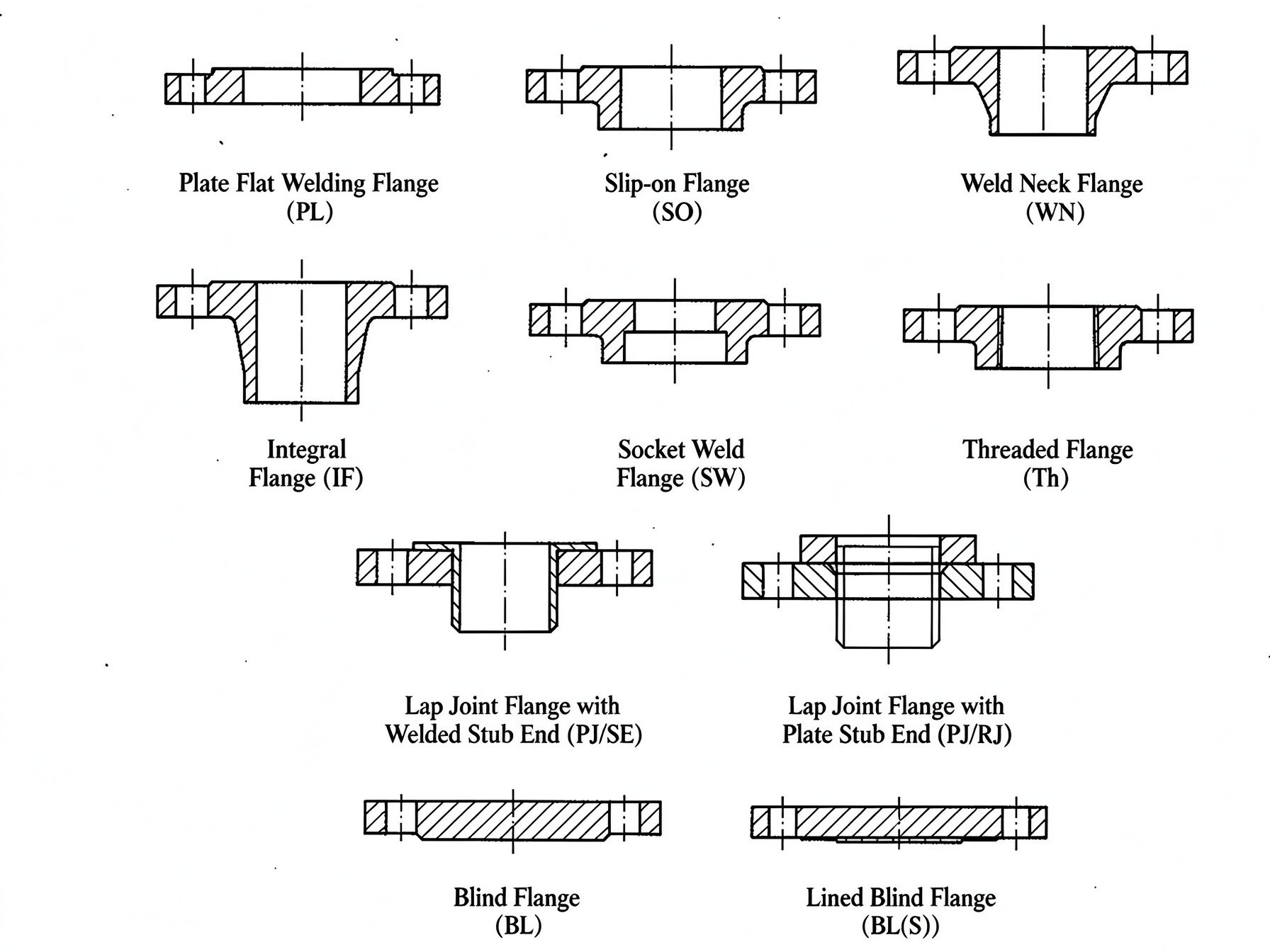
Main Types of Pipe Flanges
According to the structure and connection form, there are ten kinds of flanges commonly used in industrial piping:
1. Plate Flat Welding Flange (PL): Plate flange. A simple flat steel plate flange, welded on the outer pipe wall. Inexpensive and easy to machine, mainly used in low and medium pressure pipelines.
2. Slip-on Flange (SO): Slip-on flange with hub. It is pushed over the pipe end and fillet welded on both sides. Compared with PL flange, the hub enhances rigidity, often used for medium pressure service.
3. Weld Neck Flange (WN): Weld neck flange with tapered hub. Butt-welded with pipe, good stress distribution. Best choice for high pressure, high temperature and critical piping projects.
4. Integral Flange (IF): Flange and equipment/pipe body are machined as one piece, usually found on valves and pressure vessels.
5. Socket Weld Flange (SW): Pipe is inserted into the socket bore of flange then welded. It is the first choice for small-size high-pressure pipelines.
6. Threaded Flange (Th): Connected by pipe thread without welding. Ideal for low pressure pipelines where welding is not allowed.
7. Lap Joint Flange with Welded Stub End (PJ/SE): Used in conjunction with a butt-weld stub end. The flange ring can rotate freely, which is convenient for bolt hole alignment.
8. Lap Joint Flange with Plate Stub End (PJ/RJ): Matched with flat plate stub end, for low pressure, non-corrosive medium.
9. Blind Flange (BL): A solid flange used to close a pipe end or vessel opening. It can isolate a section of the system and support pressure testing.
10. Lined Blind Flange (BL(S)): A blind flange with a protective lining that resists corrosion. It is commonly used with corrosive substances, including acids and alkalis.
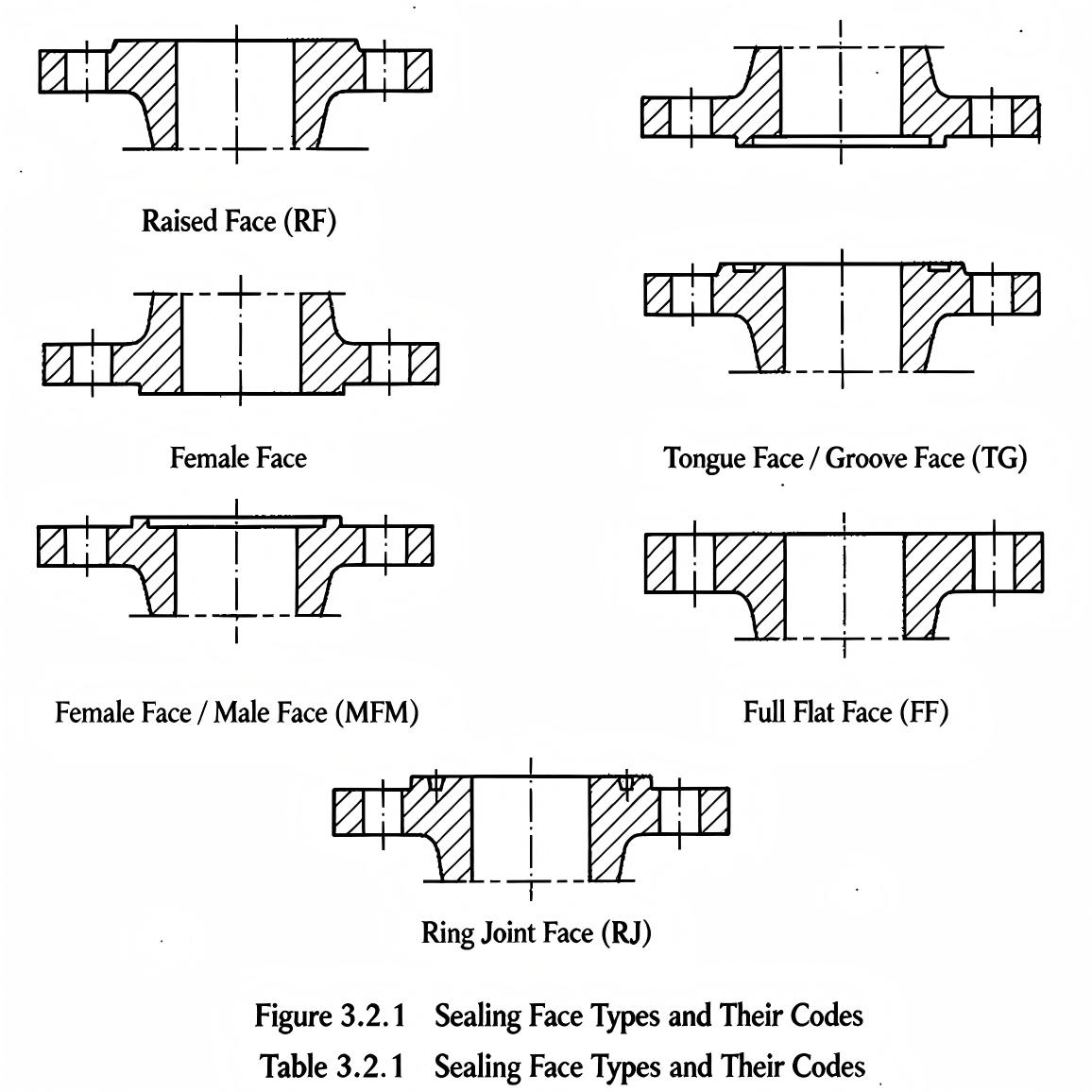
Flange Sealing Faces and Standard Codes
The sealing face is where two flanges meet. Its design plays a key role in how effectively the joint seals. Common types include:
- Raised Face (RF): A widely used design with a slightly elevated circular surface that presses against the gasket. Suitable for general-purpose pressure piping.
- Male and Female Face (MFM): The male face fits into the matching female face, helping keep the gasket in place. Often used in medium- to high-pressure applications.
- Tongue and Groove Face (TG): A tongue fits into a matching groove, where the gasket is held securely. This design can suit toxic or flammable service, as well as high-vacuum conditions.
- Flat Face (FF): The entire flange surface is flat. Typically used for low-pressure, low-temperature applications with non-hazardous materials.
- Ring Joint Face (RJ): A metal ring gasket fits into a machined groove. This type is used in demanding applications involving very high pressures or temperatures.
Our factory produces all the above types flanges, and we can also manufacture based on customers’ drawing or design according to various international standards such as EN1092-1, ASME B16.5, JIS B2220, GB, DIN. Buyers can choose different material grades (carbon steel S235JR, stainless steel, alloy steel), nominal diameter, pressure class and sealing face type based on project requirements. We offer material test certificates and complete dimensional inspection for every lot.
Choosing the correct flange style and sealing face helps to minimize the risk of leaks and increase the service life of the piping. Please contact our engineering staff, if you require technical assistance with the selection of flanges, evaluation of prints, or need a quotation for custom flanges.
Post time: Oct-15-2026


